 Advocate Aayush
Customs cases at the airport: baggage, gold and seizure
Reviewed by Advocate Aayush Agarwal · Last reviewed
If customs has detained your baggage, gold, electronics or cash at an Indian airport, there is a set legal process with strict time limits. Advocate Aayush Agarwal advises travellers and NRIs on detention, show cause notices, redemption and appeals under the Customs Act, 1962.
Quick answer
Customs officers can detain goods that were not declared or that exceed the duty-free allowance, and can seize them under Section 110 of the Customs Act, 1962. Before goods are confiscated you must receive a show cause notice and a hearing (Section 124). Goods can often be released on payment of duty and a redemption fine (Section 125), and an order can be appealed to the Commissioner (Appeals) within 60 days (Section 128).
Verify before you call: Bar Council of Delhi enrolment D/6955/2018 · full profile · all registrations
Discuss your matter on WhatsApp Call +91 90450 08046
What usually happens at the airport
- Detention: goods carried through the green channel without declaration, or above the allowance, are detained and you receive a detention receipt or seizure memo. Keep it safe.
- Statement: officers may record your statement under Section 108. It can be used as evidence, so stay calm and accurate.
- Higher-value cases: for large quantities of gold, currency or prohibited goods, arrest and prosecution provisions can apply (Sections 104 and 135).
- Leaving India soon: you can ask for baggage to be detained for return to you when you depart (Section 80).
Duty-free allowances
Under the Baggage Rules, 2016, an Indian resident returning from abroad (other than from Nepal, Bhutan or Myanmar) may generally bring goods worth up to ₹50,000 free of duty, excluding items such as gold bars and firearms. Passengers who have lived abroad for more than a year have a separate jewellery allowance: 20 grams (value cap ₹50,000) for men and 40 grams (value cap ₹1,00,000) for women. These limits are amended from time to time, so check the current notification of the Central Board of Indirect Taxes and Customs before you travel.
Your remedies, step by step
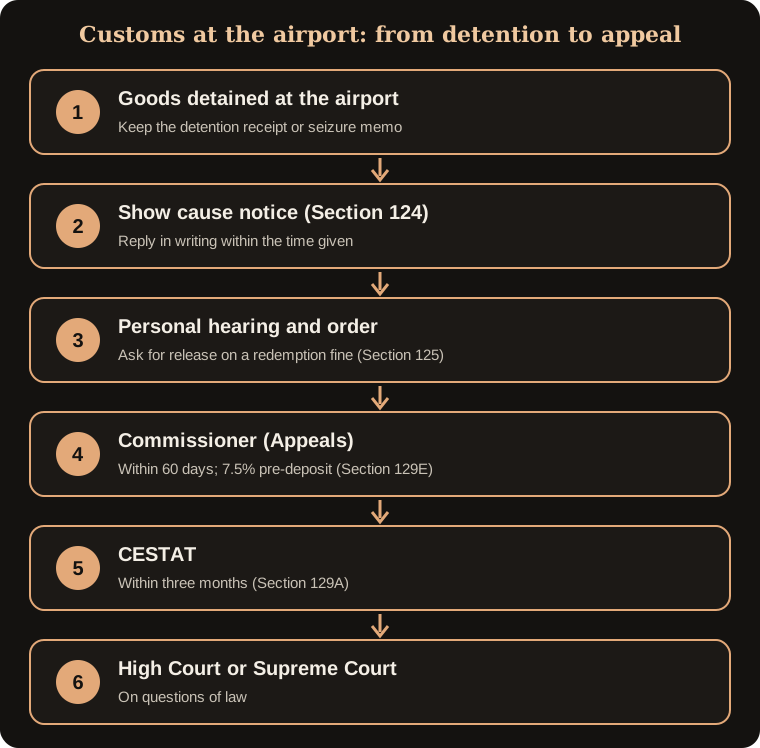
- Keep the detention receipt, seizure memo and boarding documents.
- Ask for copies of any statement you signed and of the panchnama.
- Reply to the show cause notice on time, and ask for a personal hearing.
- Ask for release on payment of duty and a redemption fine where the goods are not prohibited (Section 125).
- If the order goes against you, appeal to the Commissioner (Appeals) within 60 days (Section 128). A mandatory pre-deposit, currently 7.5% of the duty or penalty in dispute, applies (Section 129E).
- A further appeal lies to the Customs, Excise and Service Tax Appellate Tribunal (CESTAT) within three months (Section 129A).
Gold and high-value cases
Section 125 says officers shall offer release on a redemption fine for ordinary goods, but may do so for prohibited goods. The Supreme Court has held that goods imported in breach of the conditions attached to them can be treated as prohibited (Om Prakash Bhatia v. Commissioner of Customs, 2003), so release of gold is discretionary and turns on the facts: the quantity, whether it was declared, concealment and your travel history. A well-documented reply makes a real difference.
Related
Frequently asked questions
How long do I have to appeal a customs order?
Sixty days from the date the order is communicated to you, to the Commissioner (Appeals). The appellate authority can allow a further 30 days if there was sufficient cause for the delay (Section 128).
Can I get my phone, laptop or jewellery back?
Often yes, where the goods are not prohibited: by paying the duty and the redemption fine fixed in the order. For gold, release is discretionary and depends on the facts.
I live abroad and fly back soon. Do I need to stay in India?
Usually not. You can authorise an advocate to reply to the notice and attend hearings, and you can ask for detained baggage to be returned when you leave India (Section 80).
Should I sign the statement the officers prepare?
Read it fully before signing and ask for corrections. A statement under Section 108 can be used as evidence, so it must be accurate.
General information only, not legal advice on your case. Laws, allowances and notifications change; we confirm the current position before acting.